
// GAME GUIDE //
Deepwick
Free online descent game · light against the dark · no download
▶ Play DeepwickDeepwick is a free online game you play in your browser: a flame falling down a shaft of wax and rock, where one number is your health, your fuel and how far you can see. No download, no account, and every shaft is generated, so no two falls are the same.
What is Deepwick?
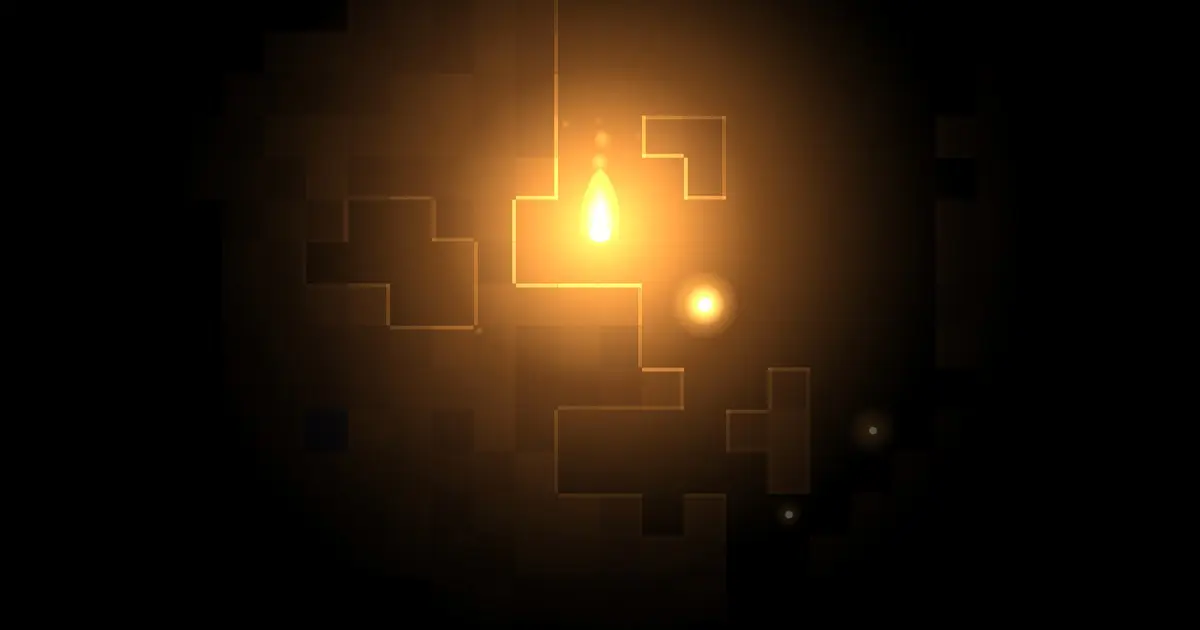
Deepwick is a game about falling. You are a small flame dropping down a shaft, and you steer left and right while gravity does the rest. How far down you get is the score, counted in metres.
The flame is the trick. It is your health, your fuel and your light at the same time. It burns down on its own, water dripping from above knocks pieces out of it, and the further it shrinks the less of the shaft you can see, so a bad stretch costs you sight exactly when you need it most. When it goes out, the run ends. Embers scattered on the way down feed it, and bigger lumps of wax feed it more.
The shaft itself is soft wax and hard rock. Wax melts when you push into it, so the fastest route is often straight through a wall. Rock does not melt, and pinning yourself against it wastes the one thing you cannot get back. Every run is generated fresh from a seed, with a path that is always passable, through five bands of 140 metres each: the waxfields, tallow hollows, the dripstone, galewound and the deep. The bands are not just a change of palette. Two things get worse the whole way down, the shaft narrowing and the proportion of unmeltable rock rising, and on top of that each band has its own signature. The dripstone is where the water is worst, and it is worse there than anywhere below it. Galewound is where the sideways gusts peak. The deep is not the hardest band on either count, it is simply the tightest and the most solid.
Death is not the end of the session. Embers you gathered bank as currency, and so does depth, at one ember for every fifteen metres. You spend them in the chandlery on four upgrade tracks with five tiers each: wick starts you with a bigger flame, tallow makes it burn down slower, shroud makes water hurt less, and ardor melts wax faster and wider. Then you fall again, further.
How to play
- Steer: one input, left and right. There is no jump and no brake.
- Burn through: push into wax to melt a way through it. Avoid the hard rock, which will only stop you.
- Feed the flame: collect embers and wax on the way down. They are the only thing that buys you more time.
- Spend: at the surface, put your banked embers into the chandlery, then go again.
Controls
On desktop the flame chases your mouse cursor, or you can use the left and right arrow keys or A and D. On a phone it is a relative drag: put a finger anywhere and pull, and the flame follows the direction rather than jumping to the touch point. ESC closes the shop and the story log. The title screen doubles as the menu, and restarting never reloads anything: the next shaft is generated on the spot. That is deliberate, because this is a game you lose a lot.
Tips from the developers
- Treat the flame as a clock, not a health bar. It is always shrinking, so hesitating at a gap costs the same as taking a hit.
- Go through the wax rather than around it. Melting is faster than steering, and the ardor upgrade makes it faster still.
- Take embers that are near your line. Crossing the shaft for one usually costs more burn time than the ember gives back.
- The dripstone is where most runs end. The water there falls thick, and shroud is the upgrade that makes that band survivable.
- Galewound pushes sideways. Steer early into a gust instead of correcting inside it.
- If you get pinned against rock, hold still against it. Your own heat cracks it into wax after about a second, and thrashing only burns you down faster.
- Depth pays even when you die badly, so a run that ends at 400 metres was still worth making.
Under the hood
Deepwick is made by MobX Games, a small indie studio in Germany. It started as a two-day build and it stayed small: there are no images and no audio files in it at all. Every wall, every drip and every ember is drawn to a canvas by code, and every sound, from the crackle to the hiss when water hits you, is synthesised in the browser as it plays. Scattered through the shaft are eighteen story fragments in lit alcoves, the first at about 55 metres and then roughly every 90 after that, and which fragment you find depends only on depth, so the story unfolds in order across many runs. The one part of the game that is genuinely hard to build is the darkness: what the light reaches, what it does not, and how to keep that cheap enough to run at full speed on a phone. That is written up in How Deepwick lights the dark.
FAQ
Is Deepwick free? Yes. It runs in the browser, with nothing to install and no account.
Does my progress save? Your best depth, your banked embers and your chandlery upgrades are stored in your browser. The shaft itself is new every run.
How long is a run? Early runs are short, and you are falling down a new shaft moments after the old one ends. They stretch out as the chandlery upgrades stack up.
Can I keep going after I go out? Once per run, if you got deep enough, the game offers a rekindle: watch a short ad and you carry on from where you went out with your flame restored. Turn it down and the run ends there. If no ad can be served, the rekindle is granted anyway.